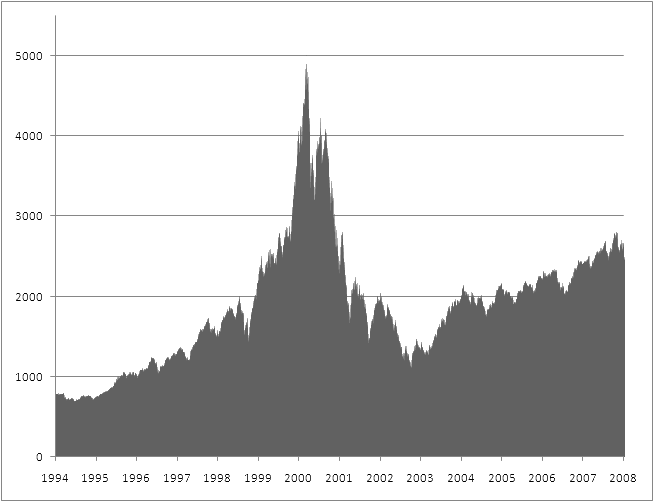
This created bubbles within the capital markets and would later trickle down into the economy. Lots of new wealth was created in this short time. Most of it was caused by the rise of financial assets, which is not backed by anything tangible. Many people did not know how to handle this new found wealth. They went out and bought multiple houses, cars, luxury items (jewelry, clothing, vacations, airplanes, boats, you get the picture), which only exacerbated our problem of having capital misallocated. The longer capital is wrongfully invested, the larger a bubble will grow.
Think about giving a kid money while his/her parents are away. If the kid has $10 a day to spend on food, the money will mostly be used on pizza or candy. Now since the pizza and candy companies are making more money, they will produce more. Since the kid doesn't want fruit and vegetables, the apple and the carrot companies have less profits and therefore produce less. This isn't healthy for the industry as a whole because they all count on one another for healthy and sustainable growth. So as you can see, allowing someone with new found wealth to spend freely, will create imbalances which lead to bigger problems.
Once the dot.com bubble popped in 2000, markets were sent crashing down and recession was imminent. Recession is actually a good thing, contrary to popular opinion. It means that businesses were growing too fast for their own good and need time for a healthy pause to almost re-balance themselves. Recessions allow the poorly allocated capital to be reallocated to productive businesses which foster economic growth. Think energy, infrastructure, utilities, semi-conductors, things that will improve our daily life and allow both people and businesses to become more efficient. A tool that can used to make investors allocate capital more productively is interest rates. An interest rate is simply the cost of money. If you have a $100 loan with a 1% interest rate, you owe the lender $1 for each interest payment. If you have a $100 loan with a 10% interest rate, you now owe the lender $10 each interest payment and must therefore invest your money wisely in order to come up with enough to cover your interest payments.
In 2000 Allan Greenspan clearly did not want the U.S. to enter recession. As I said before recession is good because the private market will reallocate capital to more productive businesses. In order to avoid recession, Greenspan lowered interest rates, with the benefit of hindsight, was one of the worst possible moves he could have made.
Here is a chart of the Federal Funds Rate from 2000-2006.

As you can see rates were cut in half in the following year and half and eventually stayed below 2% from late 2001 all the way until early 2005. Now some of you may ask why is lowering interest rates such a bad idea. Well when we had a giant bubble build up in the stock market which led to the misallocation of trillions of dollars, why would we further exacerbate the problem of misallocation by making money cheaper to borrow? Makes no sense to me.
This created the world's largest credit bubble. The credit bubble acted like a cancer, spawning new bubbles in other sectors. The most dangerous bubble, which I will write about next, was real estate. Rather than investing in stocks, which may cost anywhere from $1/share to $500/share, overnight millionaire investors could now speculate in the biggest market in the U.S. Why flip stocks when you can flip houses? Why flip houses when you can flip mansions? Tomorrow I'll go into the boom and bust of the real estate market in the U.S. and show you how that factored into this financial mess.


No comments:
Post a Comment